Measuring basics
How to read a tape measure
To read a tape measure, find the last inch number before the end of what you measure, then count the marks past it. The longer the mark, the bigger the fraction it stands for: the half inch mark is the longest, then the quarters, the eighths and the sixteenths. U.S. Tape, a tape maker, says most standard tape measures in the U.S. have markings that measure down to 1/16 of an inch.
A tape measure looks crowded, but it follows one pattern. Each inch is cut in half, then in half again, and again, and every cut has its own mark length. Once you know the pattern, you can read any length by counting marks.
The marks on a tape measure
The numbers on the blade count whole inches. Between two numbers, the marks split the inch into equal parts. The longer a mark is, the bigger the part it stands for.
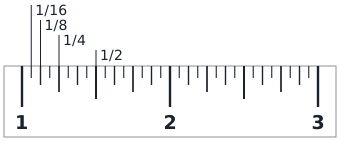
The marks in this drawing, from the longest to the shortest.
- Inch marks are the longest and carry the numbers 1, 2 and 3.
- The half inch mark sits halfway between two numbers, as at 1 1/2 inches.
- Quarter inch marks come next: 1 1/4 and 1 3/4 inches.
- Eighth inch marks fall between those: 1 1/8, 1 3/8, 1 5/8 and 1 7/8 inches.
- Sixteenth inch marks are the shortest: 1 1/16, 1 3/16 and so on, up to 1 15/16 inches.
Each kind of mark is worth twice the next shorter one. Two sixteenths make an eighth, two eighths make a quarter, and two quarters make a half.
Tapes differ, though. One tape maker notes that on some tapes, the quarter-inch marks are the same size as the eighth-inch marks. On a tape like that, count the marks from the nearest half inch or inch line instead of going by length.
Other marks and parts of a tape
Besides the inch marks, you may find these on a tape:
- The hook. The hook at the end of the blade is a little loose on purpose, so a reading starts at true zero whether you hook it over an edge or push it against one. Either way, read the tape as normal.
- Two rows of numbers. Some tapes print centimeters along the other edge. Use the inch row.
- Stud marks. Many tapes mark every 16 inches, which one tape maker calls the industry standard for studs when building a house.
- Black diamonds. Small black diamonds every 19 3/16 inches, about 19.2, are for spacing engineered floor joists: five spaces fill an 8-foot sheet of subfloor.
- Finer marks. Some tapes, such as one U.S. Tape carpenter's tape, also mark 1/32 of an inch along the first foot.
- An end between two marks. If the end falls between two marks, read the closer one.
How to read a length, step by step
- Line up the end. Hold the end of the blade at one end of what you measure, and run the blade along it.
- Find the last inch number. Read the number just before the far end. That gives the whole inches.
- Count the marks past it. Count every mark from that number to the end. Check what the smallest marks on your tape stand for: quarters, eighths or sixteenths.
- Write the fraction. The count goes on top, and the kind of mark goes on the bottom. Five marks of an eighth each make five eighths.
- Reduce it. While the top and the bottom are both even, halve both. Ten sixteenths becomes five eighths.
Worked examples
Each drawing shows part of a tape with an arrow. Work out where the arrow points, then check the steps under it.
Quarters. This tape has a mark every quarter of an inch.
- The last number before the arrow is 3, so the length is 3 inches and part of an inch.
- Count the marks from the 3 to the arrow: 3 marks.
- Each mark is a quarter, so the part is 3/4. 3 is odd, so 3/4 can't be reduced.
The arrow points at 3 3/4 inches.
Eighths. This tape has a mark every eighth of an inch.
- The last number before the arrow is 5.
- Count the marks from the 5 to the arrow: 5 marks, so the part is 5/8.
- 5 is odd, so 5/8 stays as it is.
The arrow points at 5 5/8 inches.
Sixteenths. This tape has a mark every sixteenth of an inch.
- The last number before the arrow is 7.
- Count the marks from the 7 to the arrow: 11 marks, so the part is 11/16.
- Faster: start from the half-inch mark. It is 7 1/2, which is 7 8/16. The arrow is 3 marks past it, so 8 + 3 = 11 sixteenths.
The arrow points at 7 11/16 inches.
Common misreads
- Counting the wrong kind of mark. On a tape marked in sixteenths, three marks past a number are three sixteenths. Calling them three eighths doubles the part.
- Counting from the wrong number. Count from the number before the end. You can also count back from the next number, but then you take the marks away from it.
- Leaving the fraction unreduced. Eight sixteenths is a half inch, and twelve sixteenths is three quarters. Write the short form.
- Reading at an angle. Look straight down at the point where the end meets the tape. From the side, the end can seem to sit a mark early or late.
Feet and inches
Longer lengths come in feet and inches, and a foot is twelve inches.
Feet to inches. Multiply the feet by 12, then add the inches. For 3 ft 2 in: 3 × 12 = 36, and 36 + 2 = 38 inches.
Inches to feet. Divide by 12. The whole answer is the feet, and what is left over is the inches. For 50 inches: 50 ÷ 12 = 4 with 2 left over, so 4 ft 2 in.
Adding and taking away lengths
Add or take away the inches and the fractions on their own, then tidy up. A fraction over one makes another inch, and twelve inches make another foot.
Adding. 5 1/4 in + 2 7/8 in
- Give the fractions the same bottom: 1/4 = 2/8.
- Add: 5 2/8 + 2 7/8 = 7 9/8.
- 9/8 is 1 1/8, so the total is 8 1/8 inches.
Taking away. 6 ft 3 in − 2 ft 8 in
- 3 inches is less than 8, so borrow a foot: 6 ft 3 in = 5 ft 15 in.
- Take away the feet and the inches: 5 − 2 = 3 ft, and 15 − 8 = 7 in.
- The answer is 3 ft 7 in.
Tape measure practice test
These questions are ours, written for practice. Work each one on paper, then open the answers. Some questions show a drawn tape. Each drawing's description says which stretch of tape it shows and how it is marked, but not where the arrow points, since that would give the answer away.
Try it
1. Where does the arrow point?
2. Where does the arrow point?
3. Where does the arrow point? Give the length in lowest terms.
4. Where does the arrow point?
5. A tape is marked in sixteenths. The end of a rod lines up 3 marks past the 5, and someone reads it as 5 3/8 inches. How long is the rod?
6. Which is longer, 7/8 inch or 13/16 inch, and by how much?
7. How many feet and inches is 31 inches?
8. Add 2 3/8 in and 1 1/2 in.
9. Take 3 5/8 in away from 10 1/4 in.
Show answers
- 6 1/4 inches. The last number before the arrow is 6, and the arrow is 1 mark past it. Each mark is a quarter.
- 11 3/8 inches. The arrow is 3 marks past the 11, and each mark is an eighth.
- 12 5/8 inches. The arrow is 10 marks past the 12. Each mark is a sixteenth, and 10/16 reduces to 5/8.
- 17 15/16 inches. The arrow is 1 mark short of the 18, so count back from it: 18 − 1/16 = 17 15/16.
- 5 3/16 inches. Each mark on that tape is a sixteenth, so 3 marks are 3/16. Calling them eighths doubles the part.
- 7/8 inch is longer, by 1/16. In sixteenths, 7/8 is 14/16, and 14/16 − 13/16 = 1/16.
- 2 ft 7 in. 31 ÷ 12 = 2 with 7 left over.
- 3 7/8 in. 1 1/2 is 1 4/8, and 2 3/8 + 1 4/8 = 3 7/8.
- 6 5/8 in. Borrow an inch: 10 1/4 = 10 2/8 = 9 10/8. Then 9 10/8 − 3 5/8 = 6 5/8.
Tape measure tests
A job or apprenticeship test may ask you to read a tape. In one elevator apprenticeship recruitment, the Local 126 (Hawaii) notice says applicants also take a Tool Assessment of knowledge of basic tools and their use, and of basic measuring skills. That notice does not say whether its Tool Assessment is the one the National Elevator Industry Educational Program (NEIEP) names. Our tool assessment page has what NEIEP and that local publish for elevator apprenticeship applicants. For any such test, practice until you can read a length without counting every mark.
Keep reading
- Elevator aptitude test (EIAT): the format and scoring of the aptitude test for elevator apprenticeship applicants, with a free quiz.
- How to become an elevator mechanic: the IUEC apprenticeship from recruitment to the Mechanic's Exam, with pay.
Questions people ask
How do you read a tape measure in sixteenths?
Find the inch number before the end, then count the marks past it. On a tape marked in sixteenths, each mark is one sixteenth, so ten marks make ten sixteenths. Then halve the top and bottom while both are even: ten sixteenths is five eighths.
What do the lines on a tape measure mean?
The numbered lines are inches. Between two numbers, the longest line is the half inch, then come the quarter, eighth and sixteenth inch lines, each shorter than the last. The marks on a tape measure shows them in a drawing.
What is the smallest mark on a tape measure?
U.S. Tape notes that most standard tape measures in the U.S. have markings that measure down to 1/16 of an inch. Some tapes, such as one U.S. Tape carpenter's tape, also mark 1/32 of an inch along the first foot, so check your own tape: count the marks between two numbers.
Why are some marks on my tape the same length?
Tapes differ. Some draw the quarter inch and eighth inch marks the same length. On a tape like that, count the marks from the nearest half inch or inch line instead of going by their length.
Sources
Facts on this page come from these pages. We checked each one on the date shown.
- U.S. Tape: Accurately reading a tape measure, checked October 26, 2026
- U.S. Tape: XL Series Carpenters ProTapes, scale, checked October 27, 2026
- U.S. Tape: Hidden features of a tape measure, checked October 27, 2026
- Johnson Level: review of its 1804-0025 power tape measure, checked October 27, 2026
- U.S. Tape: How to use the CenterPoint tape measure, checked October 27, 2026
- U.S. Tape: FAQs, checked October 27, 2026
- IUEC Local 126 recruitment notice, Hawaii, revised August 14, 2024, checked October 26, 2026